Internland: the rise and fall of a side project
A few years ago, I was looking for my first internship. This is the first adult experience for most people — before having to file taxes, buy houses, and so on.
It’s not that it’s tough. You have to hack your way around to find the best response rate. That’s marketing and personal branding in some way. It went well, not great, but my response rate wasn’t what was important to my eyes. I always got the chance to focus on the wrong thing. This experience made me think: there are so many websites for job seekers, often full-time/part-time positions, and they’re perfect for that. But they also contain offers for internships and apprenticeships, and they’re not caring that much about these targets. The experience isn’t designed at all for these positions.
This is how I decided to start building a job board aggregating internship offers all around France, with an experience specifically designed for student usage.
The beginning
The first thing I did back then was come up with what I call a funny name: Internland — the place where you can land your perfect internship.
I benchmarked what was already existing to identify competitors and come up with a unique angle. There were really awesome experimentations, but none scalable to my eyes — and I was looking for a very automated product. This is probably a mistake: first solve an important problem for one person, then grow. Not the opposite.
From the benchmark, I could ideate more about the product and its roadmap. A roadmap that would become reality if the MVP caught the target audience’s interest.
As we often say in the maker community: go for the quick & dirty and put out an MVP centered on a specific feature as soon as possible.
The execution
With that in mind, I started designing a one-page-fits-most landing page/app with a very Googlish UX.
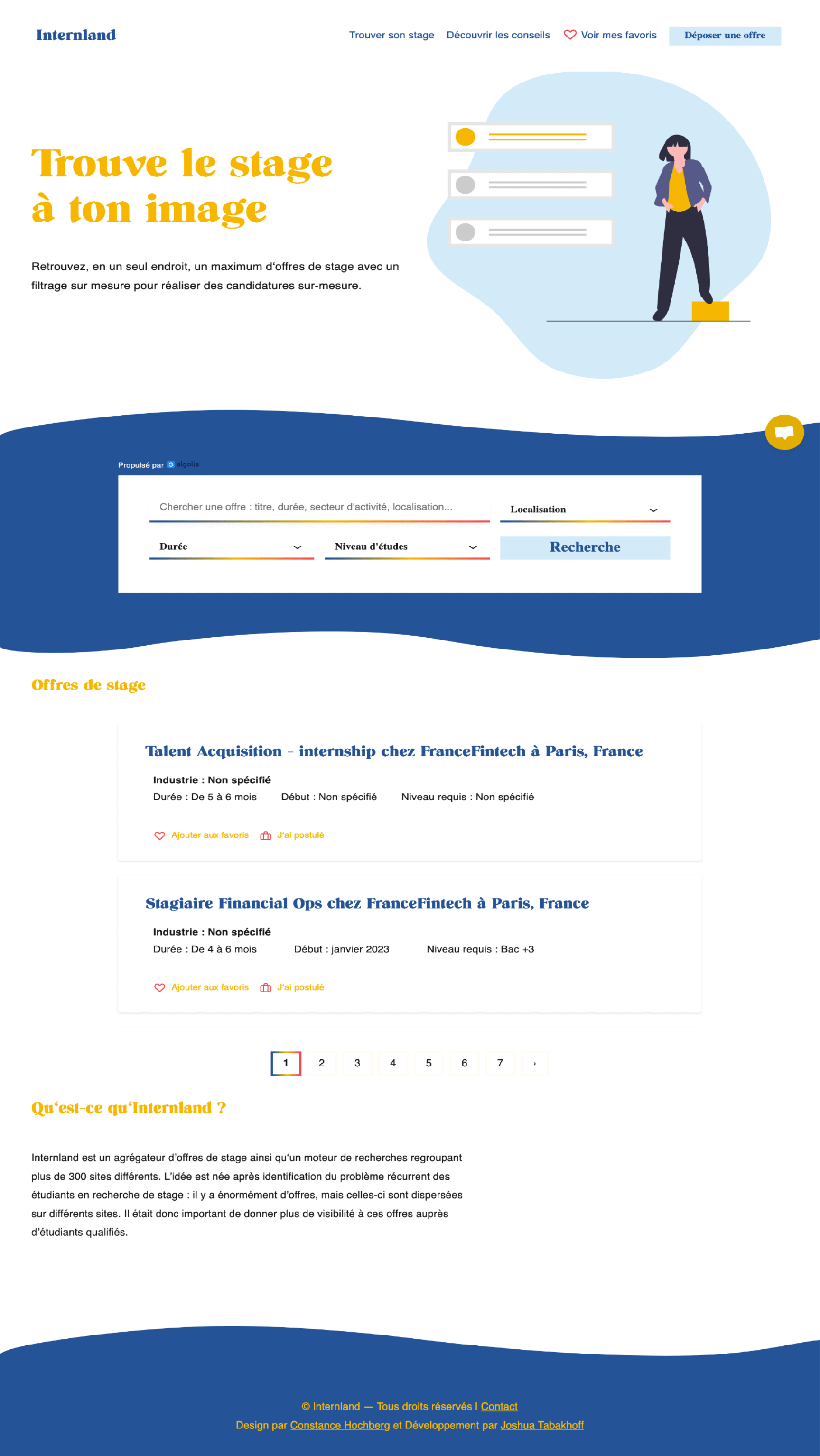
Then I wrote scrapers’ code to gather data from renowned sites and pure players. I put all that data into a serverless database called Fauna and synced it with a search engine SaaS called Algolia. As tech students, we have lots of perks — notably with GitHub Students.
The scrapers were running cron-like on a Raspberry Pi at my house. I tried to set them up on Heroku or in Lambda functions, but Puppeteer gave me a hard time. Yes, setting up a Raspberry Pi was easier — maybe it’s time for me to turn into SysAdmin?
Everything synced pretty well, even with some (many) little (huge) issues with the scraping part. Uniformizing external data into something useful is one of the toughest steps. My goal: the smoothest experience to quickly find an internship offer fitting your precise needs. To do this, you need very specific search filters.
Once everything was up and running, I decided to ignore the “beta” phase as it was already the internship season (late spring / early summer) and rushed into the release with little to no plan. Neither for my upcoming internship nor the launch of Internland.
Narrator: nothing happened.
Turns out there’s no magic traffic coming up, no overnight success. The wild far-west web. To share this exciting new project for the French market, I was very lost. Every side project I used to work on was in English, where I know a bit more about launching online (Beta List, Product Hunt, my Twitter account…). For the French market, it was a very new way of approaching this wild life. So I decided to use my most French social media — LinkedIn — and wrote a small post to announce Internland. Most of my network there is people like me, students probably also looking for an internship by then.
I was pretty new to LinkedIn copywriting (and it was way before the bullshit storm we live through now), but the stats and reach of the post were encouraging. The website got some views, and Algolia stats were very talkative about the need of a product like this. I was finally excited to work on something useful and already bringing value, or at least interest. But after the initial launch, I had little to no idea about how to keep getting traffic. As we say: “you can’t forecast stats based on the initial launch week”.
Stay motivated
It was time to get back to the workbench: how to grow the traffic? Why not launch a media focusing on tips to land an internship from 0 to 1 with do’s and don’ts? It could be a great growth relay for constant traffic and social media posts.
But do you feel the paradox of me looking for an internship and giving tips simultaneously? If a recruiter passed by and wasn’t aligned with my words, I’d have been rejected instantly and put on a blacklist. What a great way to dig your own grave.
I definitely think that fear, being paralyzed, and not having strong conviction is what loses you when working on something. I think we have to be bold, and to this date I still think I’m not ready yet to wear this cap.
This is how I let the project live its life by itself for a few months first, then for a year or so. But my intuition told me I couldn’t drop this side project without much marketing effort. Funny that I’ve said it’s all about personal branding earlier, right?
After a while, I invested some time to rank on Google on other keywords than just “internship” and “internland”. I fetched cities with over X inhabitants and created a specific page with auto-filtering so I could rank up geographically. Pressed Push. Waited 1 week, 2 weeks, 3, 4… Nothing. This made me kind of sad and desperate on how to create awareness around this project. I decided it was time to move away and work on something else, something new.
Stay hungry, stay foolish
This is the end of the story — no fancy outcomes, except that it was a great opportunity to learn a lot. I’d have loved to build what was on the initial roadmap, such as a way for students to select favorite offers and build alerts on new results. Or even better, pick offers and batch-apply in one click with a custom application — a variable-based cover letter. No AI involved.
Internland got good SEO results about 3-4 months after the update, getting organic traffic thanks to the geo-based pages. But definitely not enough to get back on it, especially as I was convinced it was time to move on.
What would you have done in this case? Move on or get back on it? Tell me on Twitter.
The last lesson I’ve learned: invest time in your SEO early on. It takes time to get results, and it could help drive traffic organically to test out your ideas.